

The Mind Traps You Can't Think Your Way Out Of: Intellectual Chew Toys

Sealed in a clear tube, burrito-wrapped in blankets, I listen to the hyperbaric chamber hiss as it pressurizes around me.
This isn’t a spa treatment. This is a high-stakes negotiation with my bleeding colon: Stop, or we both go down.

I breathe in the pure oxygen, visualizing it repairing my ulcerated intestines.
I breathe out.
I breathe in—“Wait. Is Luke1 the problem?”
Seven. Minutes.
That’s how long my brain lasted before abandoning my bleeding colon for its favorite obsession: analyzing my four-year relationship.
I wiggle my jaw to release the air bubbles trapped in my ears, but can’t dislodge the doubts bubbling up in my head:
“Is Luke creative enough for me?” Pop. “If he never changed, would I still want to be with him?” Pop. Pop. “Do I want to push mini replicas of him out of my vagina some day?”
My thoughts ping-pong off the cylinder’s walls, smacking me in the face with reality: I’m paying an absurd amount of money for eight weeks of treatment that my insurance refuses to cover, and I’m obsessing about my boyfriend.
“Focus on healing, not him!”
But Luke had become my go-to intellectual chew toy—and I couldn’t stop gnawing.
What’s an Intellectual Chew Toy?
Have you ever known a dog who, if you don’t give them something to do, they’ll find something to do? So you give Fido some kind of enrichment toy, maybe a puzzle with treats wedged inside—somewhere to channel his energy.

Well, my brain is that dog. With sharper teeth.
An intellectual chew toy is a problem your brain latches onto for hyperfixation. This puzzle must have stakes and gravitas—it must feel earth-shatteringly important—though what qualifies as “important” varies wildly. (I’ve stayed up until 1 AM frantically researching sea salt brands with the same passion others put into wedding planning.)
The thing is, I’ve always had a hungry brain.
Feed it five online classes at a time, podcasts at 2.5x speed (turning all my favorite hosts into caffeinated chipmunks), and snackable TikTok idea popcorn? It purrs.
Let that intellectual engine idle? The psychic self-cannibalism begins.
So, my brain stockpiles intellectual chew toys—anything from relationship quandaries to hypothetical arguments with strangers on the internet to existential dilemmas. Always within reach, ready to deploy. (Yes, I have ADHD. Some therapists think rumination might be how neurodivergent brains stim when our bodies can’t— like mental fidgeting for the hyperactive mind.)

Here’s what I finally realized: Our brains trick us. You think you’re solving a thinking problem—analyzing the situation, weighing options, planning your next move. But you’re actually avoiding a feeling problem. Your sophisticated supercomputer of a brain grabs an intellectual chew toy rather than face what scares it most. It’s trying to think its way out of something you can only feel your way through—in other words, you’re procrasti-feeling.
Six Steps to Drop Your Intellectual Chew Toy
The Basics
Step 1: Create a pattern interrupt
Noticing is the hardest, and most important step. So take inventory.
Do you ever find yourself:
Staring into space, perceiving nothing?
Floating somewhere outside your body?
Suddenly realizing you’ve forgotten basic human needs—water, bathroom breaks?
Paying thousands of dollars to obsess about your boyfriend while encased in a medical tube for your autoimmune disease?
If this keeps happening, you’ll need something jarring enough to snap you out of it. Pick something wonderfully ridiculous—a funny phrase, sound, image, or action that yanks you back into your real, living body.
Think of it as if you’re driving on cruise control when suddenly a flash mob of seniors in neon tutus appears on the highway median, performing the Macarena. That absurd image would snap your brain back to attention instantly.
That’s what you need to create: a circuit breaker for your thoughts.
Like yelling “Drop it!” at a dog with something dangerous in their mouth, you’re not reasoning with the thoughts or fighting them—you’re just breaking the pattern. And just like you’d praise the dog when they listen (”Good boy!”), celebrate yourself when you successfully interrupt the spiral. You’re training your brain, and that deserves recognition.
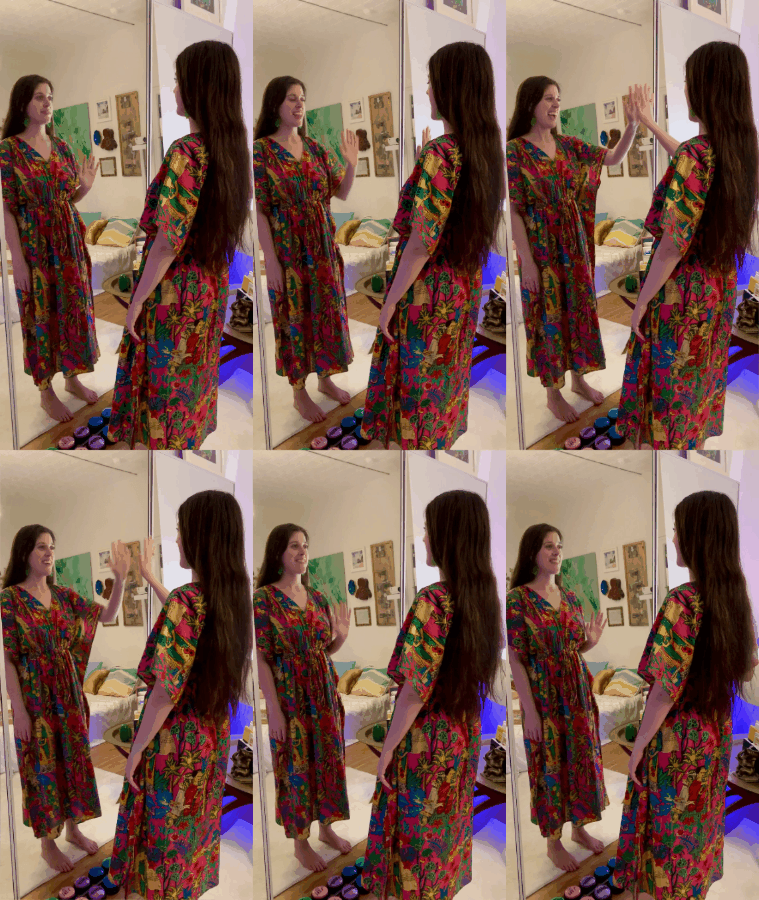
TIME FOR A REAL-LIFE DEMO!
Your internal coach is standing by 24/7. Time to tag them in!
Me: Intellectual chew toy alert!

Me: I caught the spinning! <Cue happy dance>
Internal Coach: HIGH FIVE! 🙌
Step 2: Create space to feel
Feeling problems require feeling solutions.
You wouldn’t try to cure heartbreak with calculus, would you?
First, build your emotional sanctuary:
Space and privacy? Vulnerability demands a sanctuary—not a fishbowl.
Physical needs met? Thirst, hunger, and exhaustion drown out emotional signals.
Enough time? Feelings can’t be hurried. They despise demands and deadlines.
Body comfortable? Tension blocks release.
Imagine processing your deepest emotions while crammed in a noisy café, stomach growling, hunched painfully over your phone, two minutes before meeting your intimidating boss.
That’s not just non-ideal. That’s emotional hostile architecture.

Your feelings are like skittish cats—impossible to direct, force, or rush. You can only create conditions so irresistible they choose to approach.
Next, you’ll need a compassionate witness: summon your internal coach again.
Close your eyes. Visualize your most evolved self: infinitely wise, unshakably calm, emanating compassion. This isn’t some random guru. This is you.
Talk with this higher self. Let the conversation play out in your imagination, put it to paper, or embody your internal voices: switch between chairs, or wear or remove an accessory to tangibly mark the shift between selves.
Then, redirect attention from your racing thoughts to your raw, physical sensations, such as:
Heat rising in your chest
Cold tingling in your fingertips
Tightness gripping your throat
Butterflies fluttering in your stomach
Notice the images, sounds, and metaphors that emerge. These keep you anchored in your body’s felt-sense—your interface with your feelings.
TIME FOR A REAL-LIFE DEMO!
Me: Alright. I have some time before my next meeting, and I’m going outside for a walk. Let’s do this.
Internal Coach: What do you feel?
Me: Anger.
Internal Coach: How and where do you feel it in your body?
Me: Like a fire-breathing dragon in my chest!

Internal Coach: What is this dragon-fire anger about?
Me: Luke. I NEED to be with someone who feeds my creative fire. They say you become who you spend time with. And he’s...content. Complacent. His approval of wherever I already am feels like permission to plateau. I will NOT live a beige life!
Your feelings aren’t problems to solve. They’re messengers carrying packets of vital information—if only you create the space to listen.
Step 3: Ask yourself: “What is this protecting me from feeling?”
Time to go deeper. Much deeper.
You’re conducting an emotional excavation of archaeological proportions. Each layer reveals another truth lying beneath.
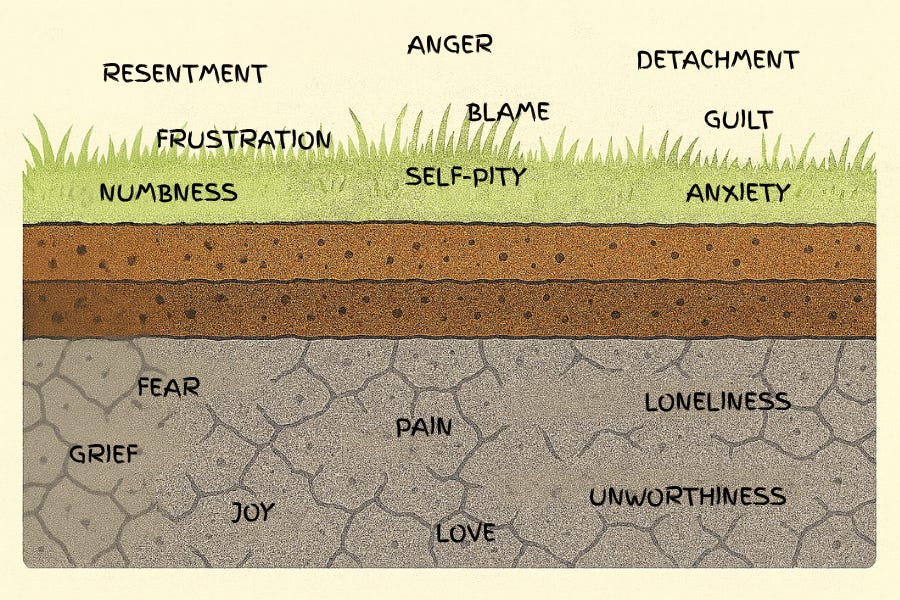
Anger often guards grief. Anxiety and frustration can mask fear. These protective layers formed strategically—to shield you from what you perceived as too dangerous to feel full on.
Keep digging. Keep acknowledging. Layer by layer, until you hit bedrock and the truth is exposed.
TIME FOR A REAL-LIFE DEMO!
Internal Coach: And under that rage, what do you sense?
Me: Intense, electric fear that Luke’s creative ceiling will become my own.
Internal Coach: And if we keep digging beneath that fear...what’s this intellectual chew toy really protecting you from feeling?
Me: Grief. A lot of it. So much energy is going toward healing my body when I just want to be making stuff. I just want to create.
Internal Coach: So you’re feeling rage, fear, and grief. Creating is super important to you, and you don’t want anyone to get in the way of that. Are we missing anything?
Me: The whole crew is here.
Your intellectual chew toys aren’t enemies. They’re guardians of your most profound truths—the ones you didn’t feel ready to face until now.
The Advanced Techniques
Step 4: Ask yourself: “Does this map onto earlier patterns?”
Sometimes steps 1-3 will free you. Sometimes they won’t.
For the most stubborn mental loops—the cockroach-like survivors after years of therapy, reading self-help books, and journaling—we need to examine your psyche’s foundations.
Your childhood didn’t merely influence you. It programmed you.
That overbearing boss consuming your thoughts? Look closer—you may see your father’s face.
That friend pulling away? Remember the familiar ache of being the neglected youngest child.
And that irresponsible cofounder? Recognize the influence of the lover who ghosted you.
It isn’t a coincidence. It isn’t bad luck. It isn’t even your fault. This is repetition compulsion—our brain’s relentless attempt to rewrite history, to finally win the unwinnable game.
The problems nagging at your unconscious aren’t new. Your psyche recycles old ones, yearning for different endings.
TIME FOR A REAL-LIFE DEMO!
Internal Coach: Does this connect to any earlier patterns in your life?
Me: No! I’ve dissected this in dozens of therapy sessions, analyzed it from every possible angle.
Internal Coach: What were some patterns in previous significant romantic relationships?
Me: Oh, I’ve totally centered my partner, orbited him and funneled my creative energy into him and our relationship. When the relationship ended, my entire life collapsed; its center, gone.
Internal Coach: Do you see that happening with Luke?
Me: Absolutely not! I vowed never again. And truly, I don’t with Luke. We don’t live together, for one. I’ve prioritized my friendships, and made sure that large chunks of my week include events and activities that light me up and don’t involve him. I’ve carefully protected my independence.
Internal Coach: So you’ve stopped the centering-your-partner pattern on the tangible level. But how about on the thought and energetic levels?
Me: Oh. Shit.
Internal Coach: How many hours a week do you spend thinking about Luke and whether this relationship is right and whether this relationship is the vehicle that will allow you to grow into the prolific, creatively expressive person you want to be?
Me: An embarrassing amount.
Internal Coach: Comparable to previous relationships?
Me: Oh god. I’m still trapped in the pattern! It’s just subtler now. I stopped it more literally, but maintained it energetically.
The most dangerous patterns usually aren’t the habits you can easily spot—they’re the ones that have evolved beyond your detection, quietly shaping your reality. Freedom becomes possible when you recognize that these hidden mental chains bind just as tightly as any visible behavior ever could.
Step 5: Ask yourself: “What do I actually need?”
The person or situation consuming your thoughts is often a placeholder for something deeper: a need that's been going unmet while your attention has been flowing outward.
TIME FOR A REAL-LIFE DEMO!
Internal Coach: If Luke’s creative output isn’t the actual problem, what is that fire-breathing dragon inside you trying to show you is the real problem? What do you actually need?
Me: I need to create. I’m projecting onto Luke. I’m angry at myself for not using my creativity to express myself more. Instead I devote most of my creative energy into analyzing Luke and our relationship and have nothing left for art.
Internal Coach: Did Luke ask for this energy?
Me: Nope.
Internal Coach: So if Luke isn’t sapping your creative energy, if he’s not the villain in this story, who is?
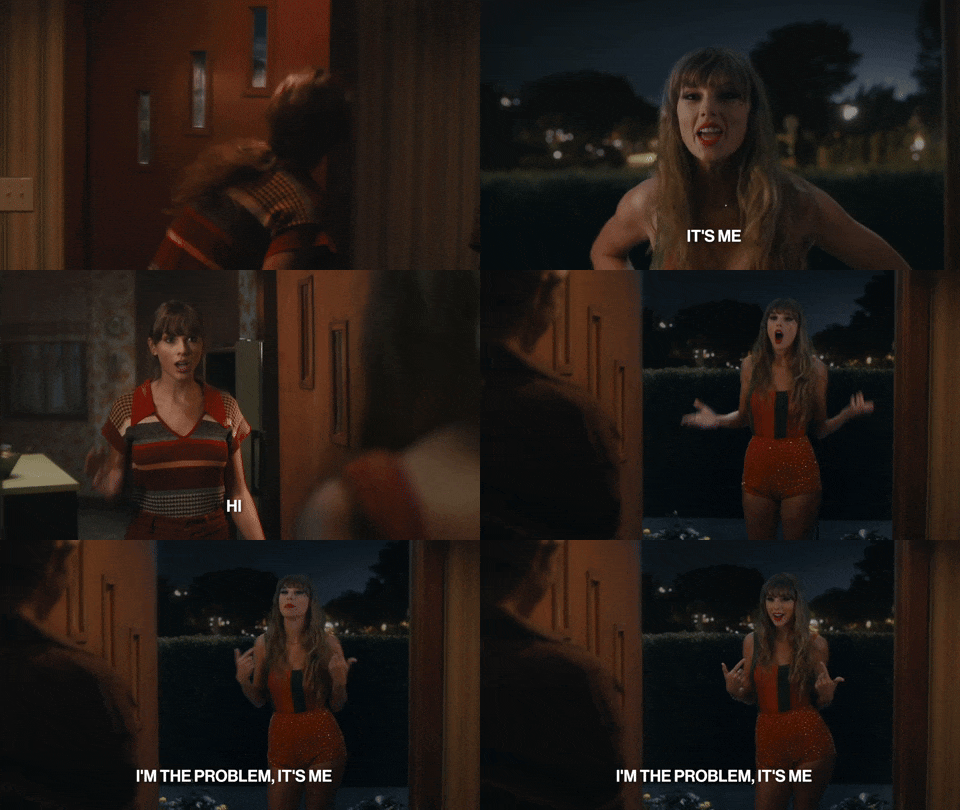
Me: In the words of T Swift: I’m the problem. It’s me.
Internal Coach: And what does that "problem" actually need?
Me: Space. Permission. For me to pour my energy into making things instead of monitoring my relationship.
Your obsession is a signal, not a sentence. It’s pointing directly at a need you’ve been outsourcing, postponing, or waiting for permission to meet.
You’ve been sitting in a cell you built, guarding a door you locked, waiting for someone else to set you free.
But you still have the keys. Ask yourself the right questions and you’ll find them.
The lock was never about them. It was about what you needed all along.
Step 6: Choose better obsessions
Your attention is a superpower. It’s the most precious, finite resource you’ll ever possess.
The question isn’t whether you’ll obsess over something.
The question is: what deserves your obsession?
Intellectual chew toys don’t just consume you in the present—they quite literally shape your future, reinforcing neural pathways that help determine who you become.

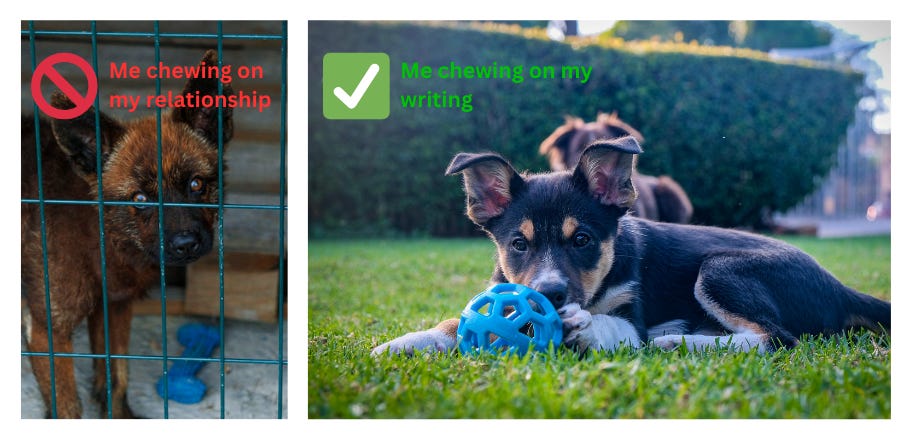
Good intellectual chew toys: Writing that novel. Building that business. Designing that garden. These thought loops can spark joy, growth, and bring tangible results. These are vibrant, fibrous “problems” that release nutrients when you chew on them.

Bad intellectual chew toys: Scheming about how to micromanage your partner’s choices. Analyzing why your friend didn’t text back. Replaying that embarrassing moment from 2017. These thought loops drain you while changing nothing. They’re like empty calories that fill you up but make you crash later.
Sometimes we’re not ready to feel our feelings. That’s human. We all need escape hatches when emotions feel too overwhelming.
But not all escapes are created equal. Some lead to growth. Others to stagnation.
But, importantly, you get to choose.
TIME FOR A REAL-LIFE DEMO!
Internal Coach: Where do you want your creative energy to actually flow?
Me: Writing. Making videos that move people. Coaching others through blocks. Building workshops that transform lives.
Internal Coach: If you created daily, would you still obsess over Luke’s creative output and its influence on you?
Me: Probably not as much. It would feel…powerful…to be so committed to my creativity that no one could derail it. Not Luke. Not anyone. It would have a nurturing home inside me and the space to frolic and play.
The Liberation
One year ago, I lay sealed in a pressurized tube, my body fighting to heal while my mind gnawed on Luke.
Today, I sit at my desk, writing these words.
I didn’t solve the riddle of, “Is Luke creative enough for me?”
I didn’t need to.
When I finally started creating again—writing, building, facilitating—my obsession with Luke’s creative output lost its teeth. Not because I figured it out. But because it was no longer the most interesting thing in the room.
That’s when we broke up.
Not with a bang. Not mysteriously, either. Quietly. Kindly. Almost obviously. Once my creative energy had somewhere else to go, our four-and-a-half-year relationship revealed what it was—and what it wasn’t—without need for further analysis.
Inside that hyperbaric chamber, I thought I was fighting for my body. I didn’t realize my creativity was fighting too—fighting for air, for space for the feelings I’d tamped down, for the life I hadn’t yet let myself make.
Luke wasn’t a saboteur. He was the safe place where my creative energy went when I was too sick and scared to make anything of my own. My brain turned him into a chew toy because I’d stopped feeding the part of me that desperately needed to create.
This essay—the first I’ve written in over a year—exists because I finally dropped the wrong chew toy and picked up the right one.
Here’s the thing I wish I’d known sooner:
You don’t defeat intellectual chew toys. You don’t outthink them. That’s their home court.
They fall out of your mouth when you finally let yourself feel—and then let what you feel move you.
Notice what your mind keeps gnawing on. That’s not the problem. That’s the placeholder. It’s pointing directly at what you’ve been afraid to feel—and what you’re starving to create.
Put it down.
Pick up your life.
I’m a professional mind-loop mender. I help bright, heady people break free from thought spirals using IFS parts work, Somatic Experiencing, and play.
Ready to drop the intellectual chew toy?
➡️ Book a free 15-minute discovery call
Want to explore on your own first?
➡️ Grab my free 6-step intellectual chew toy worksheet

P.S. I love hearing from you in the comments. If this essay hit home, or if you’re gnawing on your own intellectual chew toy, say hi below. I’ll write back!
Name changed to protect his privacy.
So beautifully written 🩷
Brilliant stuff oh my god